

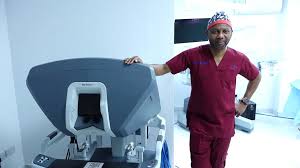
Lagos hospital performs first robotic gynaecological surgery in West Africa
Nigeria has achieved a significant medical advancement as The Prostate Clinic, a private hospital in Lagos, has successfully conducted West Africa’s inaugural robotic gynaecological surgery, representing a pivotal moment in minimally invasive healthcare within the sub-region.
Gynaecological surgery encompasses surgical interventions on the female reproductive system—specifically the uterus, ovaries, fallopian tubes, cervix, and vagina—to address benign conditions, cancers, infections, or infertility.
The procedure, performed on a 30-year-old woman on Sunday, signifies a purposeful broadening of robotic surgery at TPC from male-centric procedures to those concerning women’s health, utilizing state-of-the-art technology.
Experts have characterized this achievement as a crucial advancement in diminishing medical tourism and improving access to sophisticated care locally.
The historic surgery was conducted under the guidance of Prof. Kingsley Ekwueme, a distinguished consultant urologist and specialist in laparoscopic and robotic surgery.
In announcing this accomplishment, Ekwueme, who also serves as TPC’s Medical Director and a Consultant Robotic Surgeon, stated that this milestone underscores the hospital’s dedication to innovation in Nigeria and West Africa.
“Continuing our tradition of spearheading innovation in Nigeria and West Africa, we introduced the first surgical robot in the sub-region last year. Today, we are delighted to extend that innovation to surgeries for women.
“This young woman has been suffering from an ovarian tumour that has caused her pain and disrupted her life. Through robotic surgery, we successfully removed two large tumours, and she will be able to return home today and resume work tomorrow,” the consultant urologist remarked.
He characterized the procedure as a transformative solution for women experiencing gynaecological issues such as fibroids, endometriosis, ovarian tumors, and certain ectopic pregnancies.
He stated that robotic surgery provides considerable benefits compared to open surgery, such as decreased blood loss, a lower likelihood of infection, minimal post-operative discomfort, and shorter hospital stays, allowing patients to return to their regular activities within 24 hours.
"Once vital signs are stable, the patient can eat and be discharged within six hours. Recovery is swift, blood loss is minimal, and vital functions are maintained," he remarked.
Ekwueme further mentioned that the procedure was performed at no expense to the patient as part of TPC’s corporate social responsibility, emphasizing that the unmeasured economic losses from extended illness significantly exceed the costs associated with advanced surgical care.
He also revealed that TPC has collaborated with the Imo State Government to create a robotic surgery center, which is touted as the first of its kind in Nigeria, with the goal of fostering innovation, research, and reducing medical tourism.
"This revolution has only just begun. With appropriate partnerships and vision, Nigeria has the potential to become a center for advanced medical care, training, and research," he asserted.
Providing additional perspective, a Consultant Gynaecologist at the Lagos State University Teaching Hospital, Ikeja, and a member of the surgical team, Prof. Yusuf Oshodi, indicated that the patient underwent a thorough evaluation and was deemed suitable for robotic-assisted surgery.
"The tumor is benign, and the accuracy of robotic surgery enables us to excise only the affected tissue without jeopardizing her fertility. She will be relieved from the pain she has suffered for six months, without harming surrounding structures," Oshodi explained.
The gynaecologist noted that numerous Nigerian women endure silently from conditions such as fibroids, endometriosis, ovarian tumors, and irregular menstrual bleeding.
He indicated that fibroids are notably prevalent, impacting as many as 70 percent of women in certain communities, although only 10 to 20 percent exhibit significant symptoms.
Oshodi warned that delays in obtaining care frequently result in complications, such as anaemia and compromised heart function.
He also emphasized the advantages of robotic and minimally invasive surgery, which he claimed provides accurate treatment, shortens hospital stays, maintains reproductive capacity, and enables women to swiftly resume their normal activities.
A Consultant Gynaecologist based in the UK and another member of the team, Dr. Olaolu Aladade, remarked that the advantages of robotic and minimally invasive surgery are incomparable to those of traditional open procedures.
Aladade stated, "In open surgery, there are more complications, extended recovery times, and possible reproductive challenges. In contrast, robotic surgery allows patients to recover more quickly, return to work sooner, and experience improved psychological and economic outcomes."
Healthcare professionals have praised this achievement as a pivotal moment in Nigeria’s medical field, applauding TPC for leading innovation in women’s health.
In 2025, TPC also conducted the UroLift procedure, a groundbreaking minimally invasive surgery for men with enlarged prostates that preserves sexual function, making Nigeria the first nation in West Africa to perform this procedure.