
Oil surges, global stocks fall as Trump escalates Iran threats
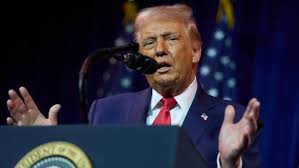
Oil prices surged, and stock values plummeted on Thursday following Donald Trump's assertion that US military forces would strike Iran for an additional two to three weeks, yet he provided no resolution regarding the closure of the Strait of Hormuz, which has severely impacted global markets.
Investors expressed their dissatisfaction with the US president's first prime-time address to the nation since the onset of the conflict, during which he reiterated his call for nations dependent on the waterway for energy resources to take action to reopen it themselves.
Trump's address contributed little new information compared to his previous statements, cautioning that "in the next two to three weeks, we will return them to the Stone Ages, where they rightfully belong."
He also informed the public that US forces would achieve all their military objectives "very, very shortly."
The announcement dampened a budding recovery in global markets, driven by Trump's assertion earlier this week that the war would conclude "very soon," while his Iranian counterpart claimed that his nation possessed the "necessary will" to bring it to an end.
Brent crude, which had dipped below $100 a barrel on Wednesday, experienced a surge of nearly seven percent, reaching $108.15, while West Texas Intermediate rose by over six percent, peaking at $106.75.
Trump "mentioned objectives achieved, yet did not address resolution. He spoke of ongoing strikes, not withdrawal. He referred to optional escalation, not closure," noted Stephen Innes from SPI Asset Management.
"The communication was not one of panic, but it was clearly indicative of unfinished business. In the markets, unfinished business serves as fuel for volatility.
"Thus, oil reacted as it typically does when the illusion shatters. It surged, not due to a sudden deterioration in the war, but because the market had prematurely anticipated its conclusion."
The response from equity traders was similarly negative, with Seoul — which had surged over eight percent on Wednesday — experiencing a decline of more than four percent.
Tokyo, Hong Kong, Shanghai, Mumbai, Singapore, Taipei, Bangkok, Jakarta, and Sydney also saw significant drops, alongside London, Paris, and Frankfurt.
Michael Brown from Pepperstone remarked that investors "sought more information than what the president provided" and that he "failed to offer a clear timeline for ending the conflict."
"The past few days have once again demonstrated that risk assets are behaving like a coiled spring, poised to surge higher on even the slightest hint of positive news," he stated.
However, he cautioned that "the war is still ongoing, commodity supply continues to tighten, and the full macroeconomic consequences of the conflict will only become apparent over time."
Markets have faced significant volatility since the onset of the US-Israeli war on Iran on February 28, with the president frequently reversing course after making policy declarations, especially concerning foreign relations and military matters.
His statements regarding the peace negotiations between Washington and Tehran have frequently been refuted by the Islamic Republic, which maintains that the Strait of Hormuz will remain inaccessible to the nation’s "enemies".
Trump’s ongoing insistence that nations dependent on energy from Hormuz should "secure your own oil" coincides with Britain’s preparations to convene a meeting of approximately 35 countries on Thursday to deliberate on the reopening of the waterway.
The meeting aims to "evaluate all feasible diplomatic and political actions that we can undertake to restore freedom of navigation, ensure the safety of stranded vessels and seafarers, and resume the flow of essential goods," stated UK Prime Minister Keir Starmer.
This address was delivered amidst escalating concerns regarding the economic repercussions of the crisis, which has prompted governments globally to implement support measures while airlines have increased fares or reduced routes.
World Bank Managing Director Paschal Donohoe expressed his apprehension about the worldwide economic consequences of the crisis.
"We are profoundly worried about the implications this will have on inflation, employment, and food security," he conveyed to AFP as the Bank unveiled a new collaboration with the International Monetary Fund and the International Energy Agency to synchronize aid efforts.
Additionally, South Korean President Lee Jae Myung, while proposing a supplementary budget of $17.2 billion to address the crisis, cautioned that the government "is treating the economy as if it were in a state of war."
Key figures at around 0810 GMT include, West Texas Intermediate: UP 6.2 per cent at $106.31 a barrel, Brent North Sea Crude: UP 6.5 per cent at $107.73 a barrel, Tokyo – Nikkei 225: DOWN 2.4 per cent at 52,463.27 (close), Hong Kong – Hang Seng Index: DOWN 0.7 per cent at 25,116.53 (close), Shanghai – Composite: DOWN 0.7 per cent at 3,919.29 (close), London – FTSE 100: DOWN 0.3 percent at 10,332.99, Euro/dollar: DOWN at $1.1531 from $1.1586 on Wednesday, Pound/dollar: DOWN at $1.3216 from $1.3305. Dollar/yen: UP at 159.57 from 158.88 yen, Euro/pound: UP at 87.24 pence from 87.08 pence, New York – Dow: UP 0.5 per cent at 46,565.74 (close).